
 Image 1 of 2
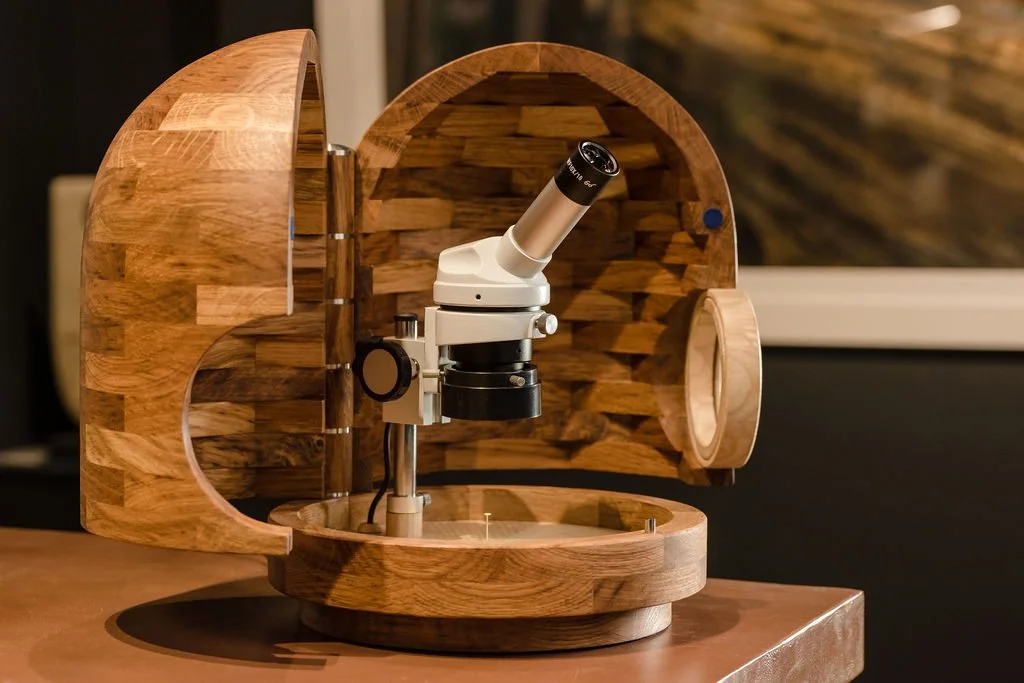 Image 2 of 2
Medium: Micro-Engraving on the Head of a Pin
Presentation: Bespoke Wooden Display Case with Integrated Microscope and Lighting System
This elegant micro‑engraving captures the expressive silhouette of a violinist, carved entirely by hand onto the head of a pin, a surface only millimetres wide. Invisible to the naked eye, the artwork reveals itself only under magnification, where the delicate posture, flowing lines, and poised bow arm emerge with remarkable clarity. The piece transforms one of the smallest possible canvases into a celebration of music, movement, and human expression.
Working on the head of a pin is among the most technically demanding challenges in miniature art. The surface is curved, reflective, and unforgiving, requiring absolute precision to avoid slipping or distorting the engraving. Under a powerful microscope, Graham Short uses ultra‑fine needles and custom‑engineered tools to carve each microscopic line with near‑motionless accuracy. The angle of the violin, the sweep of the bow, and the subtle shaping of the figure must all be formed one microscopic cut at a time. Even the smallest elements, the suggestion of rhythm, the balance of the composition, the grace of the musician’s stance, are engraved at a scale measured in microns.
Short’s famously disciplined working methods underpin the creation of this piece: late‑night sessions when vibrations are minimal, controlled breathing, and pulse‑slowing techniques that allow him to engrave with absolute steadiness. The result is a miniature artwork that captures both the technical brilliance of the craft and the emotional resonance of live performance.
To present the artwork as intended, the engraved pin is housed in a bespoke wooden display case designed specifically for micro‑engravings. The integrated microscope and adjustable lighting system allow viewers to explore the engraving in perfect clarity, revealing details that would otherwise remain invisible. The warm wood, precision optics, and soft illumination create a museum‑grade presentation that honours both the subject and the craftsmanship.
Medium: Micro-Engraving on the Head of a Pin
Presentation: Bespoke Wooden Display Case with Integrated Microscope and Lighting System
This elegant micro‑engraving captures the expressive silhouette of a violinist, carved entirely by hand onto the head of a pin, a surface only millimetres wide. Invisible to the naked eye, the artwork reveals itself only under magnification, where the delicate posture, flowing lines, and poised bow arm emerge with remarkable clarity. The piece transforms one of the smallest possible canvases into a celebration of music, movement, and human expression.
Working on the head of a pin is among the most technically demanding challenges in miniature art. The surface is curved, reflective, and unforgiving, requiring absolute precision to avoid slipping or distorting the engraving. Under a powerful microscope, Graham Short uses ultra‑fine needles and custom‑engineered tools to carve each microscopic line with near‑motionless accuracy. The angle of the violin, the sweep of the bow, and the subtle shaping of the figure must all be formed one microscopic cut at a time. Even the smallest elements, the suggestion of rhythm, the balance of the composition, the grace of the musician’s stance, are engraved at a scale measured in microns.
Short’s famously disciplined working methods underpin the creation of this piece: late‑night sessions when vibrations are minimal, controlled breathing, and pulse‑slowing techniques that allow him to engrave with absolute steadiness. The result is a miniature artwork that captures both the technical brilliance of the craft and the emotional resonance of live performance.
To present the artwork as intended, the engraved pin is housed in a bespoke wooden display case designed specifically for micro‑engravings. The integrated microscope and adjustable lighting system allow viewers to explore the engraving in perfect clarity, revealing details that would otherwise remain invisible. The warm wood, precision optics, and soft illumination create a museum‑grade presentation that honours both the subject and the craftsmanship.